
Construction ERP
ERP vs. Traditional Project Management: Which Works Best for Modular Construction?
Last updated:
November 23, 2025
.jpg)
Introduction – The Shift Towards Modular Construction
Why Modular Construction is Gaining Popularity
Modular construction is revolutionizing the way. Rather than constructing everything on-site, sections of the building—walls, floors, even rooms—are built in a controlled environment and then pieced together like giant LEGO blocks.
Why is this method becoming more popular?
- Shorter Timelines: Because off-site and on-site construction occur at the same time, projects complete up to 50% quicker.
- Cost Savings: Less labor, less waste, and fewer delays translate to less cost.
- Improved Quality Control: Factory conditions provide accuracy, as opposed to uncertain on-site environments.
However, although modular construction brings great advantages, coordinating these projects isn't always a breeze.
Challenges of Managing Modular Construction Projects
Consider this—your factory crew is constructing modules, your on-site team is preparing the foundation, and your logistics crew is organizing transport. If even one link in this chain lags behind, everything gets held up. Some of the most common headaches are:
- Supply chain problems: A delayed material delivery can stop production dead.
- Poor coordination: Off-site and on-site teams working in silos create misalignment.
- Budget blowouts: Without real-time financial monitoring, costs can get out of control quickly.
Most companies use spreadsheets, email, and phone calls to multitask. But let's face it—that's trying to control a high-speed race using a clipboard and Post-it notes. That's where ERP (Enterprise Resource Planning) comes to the rescue.
Understanding Traditional Project Management in Modular Construction
How Traditional Project Management Operates
Spreadsheets and stand-alone project management tools are still utilized by most construction companies.
This might be fine for small projects but breaks down with increased complexity.
Picture attempting to keep tabs on a modular construction in which factory manufacture, site prep, and materials delivery have to all happen together.
When one thing does not go as planned, old school methods usually put you responding afterward, not averting the problem initially.
The Limitations of Spreadsheets and Manual Coordination
- Data Discrepancies Compound: One misplaced formula within a spreadsheet and your entire budget is out of whack.
- Decisions Are Based on Outdated Info: If your data isn’t live, you’re always one step behind.
- Collaboration Is a Mess: Scattered emails, phone calls, and notes lead to confusion and delays.
How ERP Transforms Modular Construction Management
1. Centralized Project Planning and Scheduling
ERP brings everything—factory production, site prep, logistics—into one real-time system, so everyone stays in sync.
- No more guesswork: You’ll know exactly where each module is in the process.
- Faster decision-making: View schedule changes in real time and adjust on the fly.
2. Supply Chain and Inventory Management
- Supply chain delays are the nightmare of a modular project. ERP facilitates by:
- Monitoring materials in real time, so you always know what's coming in when.
Cutting waste with precise demand forecasting.
3. Financial Control and Cost Optimization
- Eliminate budget surprises: Real-time cost tracking keeps expenses in line.
- Forecast smarter: Get precise estimates based on historical project data.
4. Improved Collaboration Across Disciplines
ERP integrates architects, engineers, contractors, and suppliers onto a single platform. That means:
- Instant approval—no more delays waiting for email replies.
- Fewer miscommunications, and projects remain on schedule.
5. Compliance and Quality Control
Compliance is simpler with ERP's automatic tracking of:
- Regulatory compliance—each module is guaranteed to meet standards.
- Quality control checks—off-site and on-site.
ERP vs. Traditional Project Management – A Feature Comparison
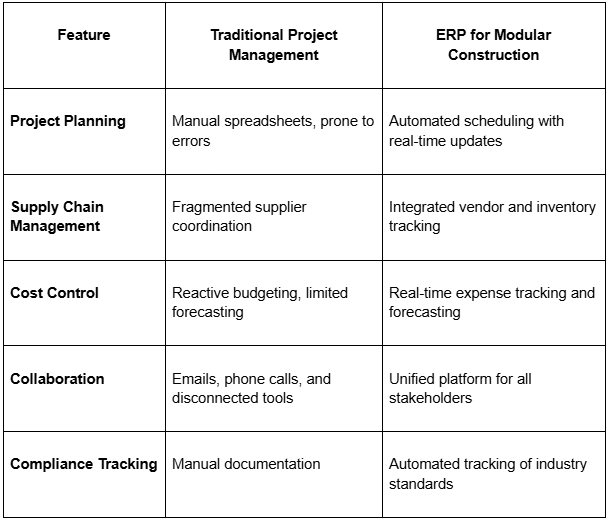
Key Considerations When Choosing an ERP for Modular Construction
Must-Have Features for Modular Construction ERP
Not all ERPs are created equal. See if your features include:
- Real-time project monitoring
- Supply chain management integrated
- Cost budgeting and forecasting
- Smooth team collaboration
- Compliance and quality monitoring
Cloud vs. On-Premise ERP: What's the Best Fit?
- Cloud ERP: Access data from anywhere, perfect for scalability.
- On-Premise ERP: Greater control but needs IT upkeep.
ROI: How ERP Provides Long-Term Cost Savings
- Shorter completion times → More projects yearly.
- Better budget control → Fewer cost overruns.
- Improved efficiency → Happier clients and repeat business.
Conclusion – Making the Right Choice for Your Modular Projects
When to Upgrade from Traditional Project Management to ERP
If you’re constantly dealing with delays, budget issues, and miscommunication, it’s time to level up. ERP isn’t just a tool—it’s a must-have for modular construction success.
Steps to Successfully Implementing ERP in Modular Construction
- Identify your needs – What areas is your existing system lacking in?
- Select the proper ERP – Industry-specific functionality should be the focus.
- Training your staff – Adoption is success.
- Phased go live – Begin small, then expand.
Final Thoughts – The Future of ERP in Construction
Modular construction is the future, but traditional project management can’t keep up. ERP ensures real-time tracking, better financial control, and seamless collaboration, so your projects run smoother, faster, and more profitably.
If you’re ready to take your modular projects to the next level, ERP is the way forward.
FAQ’s
Why is modular construction harder to manage with traditional project tools?
Modular projects rely on tight coordination between factory production, on-site preparation, suppliers, and transport. Spreadsheets and scattered communication can’t sync these moving parts, leading to delays, waste, and budget issues.
How does an ERP improve modular construction management?
ERP centralizes schedules, procurement, logistics, budgets, and communication into one real-time system. Everyone sees the same updates, reducing misalignment and enabling proactive decision-making.
Can ERP help prevent delays in modular construction?
Yes. ERP tracks factory output, material availability, transport timelines, and crew schedules simultaneously. When something slips, the system updates downstream tasks instantly to avoid bottlenecks.
What advantages does ERP offer over traditional project management?
ERP delivers live data, automated workflows, accurate forecasting, integrated supply chain visibility, better cost control, and unified collaboration. Traditional tools only show fragments of the project, often too late to act.
What features should a modular construction ERP include?
Essential capabilities include real-time scheduling, integrated supply chain management, cost forecasting, compliance tracking, cross-team collaboration, and the ability to link off-site production with on-site activities seamlessly.


