Construction Supplier Bid Management: How to Manage RFQs From Submission to Award
Most suppliers who lose a winnable bid lose it on a missed deadline or a quote that went quiet, not on price. Here’s how to manage RFQs from intake to award so fewer winnable bids slip away.
 Sneha Kumari
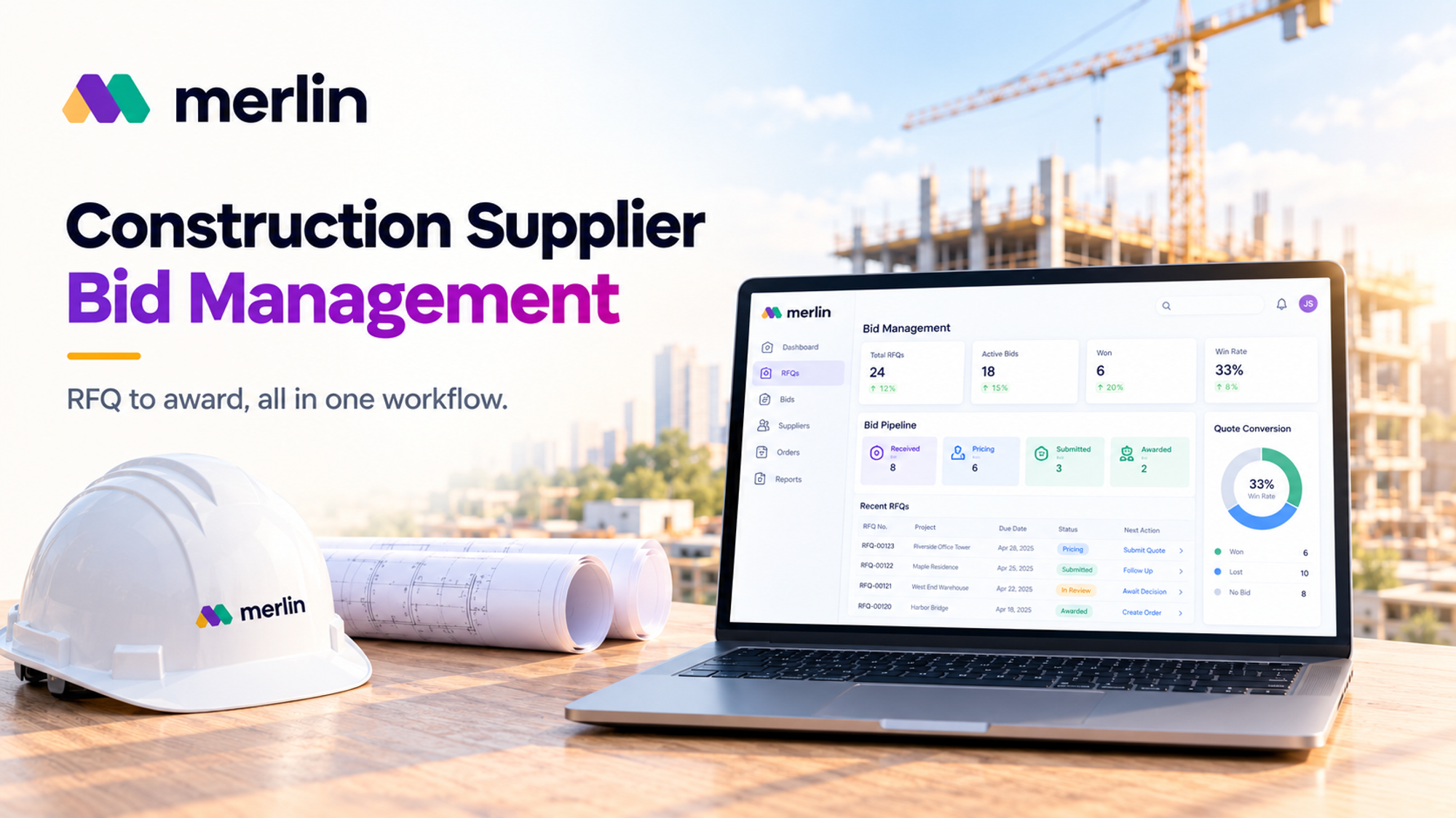
Most suppliers who lose a winnable bid never lose it on price. They lose it on a deadline nobody tracked, or on a quote that went quiet the moment it was sent.
Construction supplier bid management is the process of handling RFQs from the moment they are received through contract award: deciding whether to bid, tracking deadlines, submitting a compliant quote, following up, and converting the win into an order. Without a system, the pattern is predictable. Invitations get buried, addenda get missed, and once a quote is submitted, nobody owns the next move.
Each stage leaks bids in its own way, and each can be fixed with a few consistent habits.
What Is Construction Supplier Bid Management?
Construction supplier bid management is the structured process a supplier, fabricator, or manufacturer uses to handle every request for quotation (RFQ) from the day it arrives to the day it is awarded or lost. It replaces scattered inboxes and memory with a managed pipeline where every bid has an owner, a deadline, and a status. Construction bid management is the broader label for the same discipline. The supplier version simply looks at it from the seller's side of the table.
The full lifecycle moves through six stages:
- Intake: capture every RFQ in one shared place the moment it arrives.
- Qualify: decide whether the job deserves your estimating time.
- Track: log deadlines, addenda, and a single owner for each bid.
- Submit: send a complete, compliant quote before the deadline.
- Follow up: stay visible until the buyer decides.
- Award: confirm scope, convert the win into an order, and record the result.
Depending on the market and the buyer, the same opportunity may be called an RFQ, an invitation to bid, or a tender. Construction tender management and construction RFQ management describe largely the same work, so the process below applies whichever word your customers use.
One boundary is worth drawing. This is a process article, not a pricing one. How you build your numbers and protect your margin is covered in our construction supplier pricing strategy guide. Here, the focus is everything that happens around the price.
Receiving and Qualifying RFQs
Strong construction RFQ management starts before a single hour of estimating is spent. When a package arrives, log it first, then read it for fit.
A typical RFQ package includes:
- Scope of supply: the products, quantities, and specifications to be priced
- Drawings and specification sections: usually carrying revision letters
- Key dates: the question deadline, the submission deadline, and the expected award date
- Delivery requirements: lead times, phasing, and site access
- Commercial and compliance terms: insurance, certifications, warranties, and payment terms
Once the package is logged, run it through a short go or no go screen. Four questions do most of the work:
- Trade fit: does the scope match what you actually make, stock, or install?
- Crew capacity: do you have the estimating time to price it before the deadline, and the production or supply capacity to deliver if you win?
- Client quality: does this buyer pay on time, award fairly, and treat quotes as real opportunities rather than price checks?
- Profit potential: does the likely margin justify the estimating effort?
A simple score from 1 to 5 on each question makes the call fast and consistent. Record a "no bid" with a reason, just as you would record a win. Over time, those reasons sharpen your criteria.
Why scattershot bidding backfires. Pricing everything feels safe, but it is expensive. Every hour spent on a poor fit job is an hour taken from a better one, and a thin, rushed quote on a job you never wanted rarely wins anyway. Without a qualification filter, estimating hours drain into low odds pursuits while your strongest opportunities get the same attention as your weakest.
Selectivity is easier when the pipeline is healthy. Suppliers working on a steadier flow of invitations can read how to get more construction RFQs without cold calling. Either way, the front end of a repeatable RFQ tracking process is the same: capture, score, decide, assign.
Tracking Bids and Submission Deadlines
Construction bid tracking is where many suppliers lose bids they should have won. The fix is a bid register, sometimes called a bid board: one shared record of every live pursuit, whether it sits in a spreadsheet or in software.
A useful bid register captures:
- Project metadata: project name, location, customer, contact, and scope summary
- Due dates: question cutoff, submission deadline, and expected decision date
- Pipeline stage: received, qualified, in pricing, submitted, in follow up, awarded, lost, or no bid
- A single owner: one named person accountable for each bid
- Value and effort: quote value, target margin, and estimating hours spent
- Version data: current drawing revision, addenda received, and quote revision number
- Outcome: the result, the reason for the win or loss, and what you learned
One owner per bid. Shared responsibility tends to become no responsibility. When two people each assume the other is watching a deadline, neither is. A single owner, with a named backup for absences, closes that gap. Bid deadline management then becomes simple: every date lives in the register, reminders fire ahead of each one, and your internal cutoff sits a day before the buyer's.
Addenda and version control. Buyers change scope while bids are open. Addenda shift quantities, swap products, and move dates. A supplier pricing from an outdated drawing set submits a number for a job that no longer exists, and the result is a rejected quote or a win at a price that does not cover the real scope. Log every addendum with its date, confirm receipt, and stamp each quote with the drawing revision and addenda it reflects.
The risk of manual tracking. Industry estimates suggest that 99 percent of subcontractors who track bid invitations in email or spreadsheets miss multiple invitations every year. Suppliers working through the same channels face the same exposure. It is not carelessness. Invitations land in personal inboxes, get forwarded, and sink under newer messages, while spreadsheets stay current only when someone remembers to update them. Effective supplier bid tracking routes every invitation into one shared place, ties reminders to deadlines, and records status changes as they happen.
For suppliers who would rather work inside the buyer's procurement process than beside it, MerlinAI's construction ERP platform includes Merlin Merchant, which places suppliers directly in live project workflows. The RFQ arrives, the quote is priced in the platform, and it enters the buyer's evaluation without an email chain in between.
Preparing and Submitting Compliant Bids
Construction bid submission is largely a compliance exercise. A well priced quote that arrives incomplete can be set aside before anyone reads the number. Pricing mechanics sit elsewhere, so this section covers what to confirm before you send.
Required documents usually include:
- The completed quote or bid form, in the format the buyer specified
- Written acknowledgment of every addendum issued
- Insurance certificates, licences, and certifications
- Data sheets or technical submittals for the products quoted
- Any signed declarations, references, or forms named in the instructions
- Lead time, delivery terms, and quote validity period
The most common disqualification triggers are avoidable:
- Missing the deadline, even by minutes, or sending to the wrong address or portal
- Failing to acknowledge an addendum
- Attaching expired or missing documents
- Quoting a product that differs from the specification without flagging it as an alternate
- Altering the buyer's form or terms without permission
Scope clarity matters as much as paperwork. State what the price includes and what it leaves out: delivery to site, offloading, installation, taxes, testing, storage, and spares. Name your assumptions, such as which drawing revision the quantities came from. Clear inclusions and exclusions protect you from disputes later and make your quote fair to compare.
Handling revisions. If scope changes after you submit, send a revised quote rather than editing the original. Give it a new revision number and date, add a short note on what changed, and update the register so your team and the buyer are working from the same current version. That is the cleanest way to manage bid submissions and revisions without confusion.
Following Up After Submission
Submitting a quote is not the end of the work. Silence after submission is the second reason suppliers lose winnable bids: the buyer is busy, evaluation drags, and the supplier who stays visible is the one remembered when decisions are made. Industry estimates suggest that follow up influences 20 to 25 percent of award decisions, which makes it one of the cheapest ways to improve your odds.
A simple cadence keeps construction bid follow-up consistent:
- Within 48 hours: confirm the quote arrived, check that nothing is unclear, and offer to answer technical questions
- After one week: ask where the buyer is in evaluation and whether the timeline has moved
- After two weeks: ask about the decision date, share anything useful such as updated lead times or stock availability, and ask what is standing between your quote and a decision
Log each contact in the register so bid status tracking stays accurate: submitted, clarifications requested, shortlisted, negotiating, awarded, lost, or on hold. Every open bid should carry a next follow up date. A bid with no scheduled next step is a bid nobody is working.
Make each touch useful. "Just checking in" adds little. A clarified detail, a lead time confirmation, or an alternate product option gives the buyer a reason to reply.
When the answer is "your price is too high," resist the urge to discount on the spot:
- Ask for specifics: how far apart are the numbers, and what are they being compared against?
- Check scope alignment: a lower quote often leaves out items yours includes
- Offer options before cuts: an alternate product, phased delivery, or adjusted quantities can close a gap without cutting margin
- Trade instead of giving: if you reduce price, ask for something in return, such as a larger commitment, faster approval, or a simpler delivery schedule
- Know your floor: set a minimum margin before the call, not during it
A discount handed over blind teaches buyers that your first number was negotiable. A structured response protects both the margin and the relationship.
Managing Bid Awards and Converting to Contracts
A Notice of Award is a milestone, not a finished sale. The construction bid award process has a gap between "you won" and "you hold an order you can act on," and bid award management is the work of closing it.
At Notice of Award, confirm three things:
- Final scope alignment: compare the awarded scope, quantities, and delivery dates against what you quoted, and resolve any differences in writing
- Compliance verification: make sure insurance, certifications, credit terms, and submittals are in place and current
- Commercial terms: confirm price validity, payment terms, any escalation clause, and the delivery schedule
Once aligned, convert the awarded bid into a purchase order or subcontract. Check that the document matches your quoted price, quantities, and terms before you commit production or buy materials, and record the PO number against the bid in your register so the bid and the order stay linked.
The stretch between award and order is where deals quietly stall. Reading what happens between supplier selection and the first purchase order shows how that handoff works from the buyer's side, which helps you anticipate delays.
Measuring performance turns the register into a decision tool. Track three numbers:
- Bid hit ratio: bids won divided by bids submitted. Winning 10 of 40 bids gives a 25 percent hit rate, or a 4:1 ratio. Break it down by customer, project type, and product category, because the split is where decisions live.
- Time to decision: days from submission to outcome. Long cycles tie up capacity and make forecasting harder.
- Bid to award conversion: the share of awarded bids that become a confirmed PO or contract. A gap here means wins that never turn into revenue.
Record the reason behind every loss, and ask the buyer for feedback where you can. Each answer feeds back into your go or no go criteria, which is how the process improves with every bid.
Frequently Asked Questions
What is the difference between an RFQ, a tender, and a bid?
An RFQ is a request for a priced quotation on a defined scope of products or services, usually with a short deadline. A tender is the formal term many markets use for a competitive invitation to price, often with stricter submission rules. A bid is simply your priced response to either one. In practice the terms overlap, and the same bid management process handles all three.
What should a construction bid register include?
At minimum: project details, customer and contact, due dates, pipeline stage, a single owner, quote value, version and addenda data, and the outcome with a reason. These fields let you see every live bid at once, spot deadline risks early, and measure performance later.
How do I track bid status from submission to award?
Use a fixed set of statuses, such as submitted, clarifications requested, shortlisted, negotiating, awarded, lost, and on hold. Update the register after every buyer contact, and pair each status with a next follow up date so no bid goes quiet unnoticed.
What should I do after losing a bid?
Record the reason, ask the buyer for feedback, and note who won if you can find out. Work out whether the cause was price, scope, timing, or fit. Patterns across several losses show whether to adjust your go or no go criteria, your quote presentation, or your follow up.
How can suppliers improve construction bid tracking and follow up?
Move every invitation into one shared register, assign a single owner per bid, set reminders ahead of each deadline, and schedule follow up at 48 hours, one week, and two weeks. Review hit ratio and time to decision monthly. Those habits fix most of the missed deadlines and silent bids that cost suppliers work.