Construction Material Procurement: How to Reduce Costs, Manage Suppliers, and Prevent Delays
A steel delivery two weeks late is never a two week problem. Here's how to run construction material procurement to cut costs, manage suppliers, and prevent delays.
 Sneha Kumari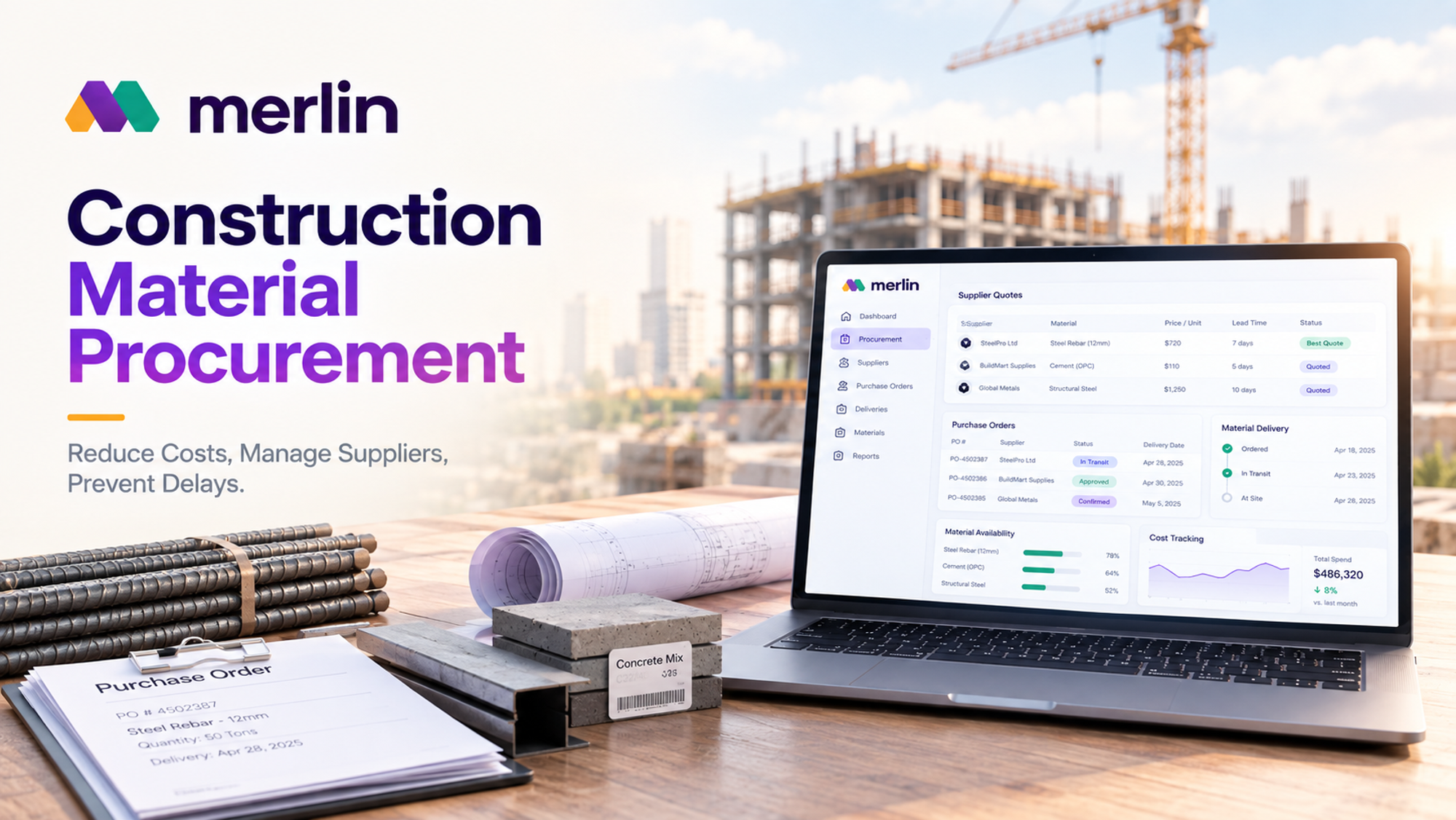
A steel delivery that lands two weeks late rarely stays a two week problem. Crews stand idle, trades get resequenced, and the premium for rushed freight lands on a fixed price contract that had no room for it.
Construction material procurement sits behind that chain of events. It decides whether the right material arrives at the right cost on the right day, and on most projects it accounts for a large share of total spend. Teams that treat it as a managed discipline rather than a purchasing chore protect margin and schedule at the same time.
What Does the Construction Material Procurement Process Involve
The construction material procurement process takes a project from a list of required materials to verified stock that is ready for installation. It runs through five connected stages: defining requirements, planning the budget, selecting suppliers, securing approvals and purchase orders, and managing delivery, inspection, and inventory. Because each stage feeds the next, a mistake early in the process usually shows up later as extra cost or lost time.
Material Requirements and Specifications
Everything starts with the design package. Architects and engineers produce drawings, specifications, and a bill of quantities that define what each material must be and how much the project needs. Procurement teams then translate those documents, along with BIM data where it exists, into a material requirements list with expected delivery dates.
Vague specifications are one of the most common causes of wrong orders, so clarify them before anything is priced.
Estimation and Budget Planning
Estimators calculate quantities and costs from the drawings and specifications. Procurement teams then check those figures against current market rates, possible vendor discounts, and realistic lead times. Most teams add a contingency of 5 to 10 percent to absorb price movement between estimate and purchase.
RFQs and Supplier Selection
Contractors issue requests for quotation (RFQs) or invitations to bid to suppliers and fabricators. The quotes that come back set out unit prices, lead times, minimum lot sizes, and payment terms. Standard commodities can often be bought from established vendors on agreed terms, while custom or engineered items justify a full competitive round.
Submittals, Approvals, and Purchase Orders
Before anything is bought, the contractor sends product data, samples, shop drawings, and manufacturer certifications to the design team and owner for written approval. Once approved, the contractor issues a purchase order (PO) that turns the accepted quotation into a binding agreement covering quantities, pricing, delivery dates, and jobsite location.
For custom or engineered materials, the PO is also the trigger for fabrication to begin.
Delivery, Receiving, Inspection, and Inventory
Procurement managers track shipments against the master schedule and plan offloading, including cranes, forklifts, and rigging. On arrival, materials are checked against the PO and delivery documents for quantity and visible defects. Technical testing, such as concrete strength or rebar tests, confirms performance where required.
Conforming materials are admitted to inventory and tracked through barcodes, RFID tags, or ERP records. Nonconforming items are rejected and returned under contract terms. Stock is then released to crews in line with daily work plans.
Where Do Construction Material Procurement Costs and Delays Come From?
Most construction material procurement costs and delays come from five connected sources: volatile prices, long lead materials, inaccurate quantity planning, slow submittal approvals, and storage, logistics, and cash flow limits. They rarely act alone. A late approval shortens the fabrication window, which forces expedited freight, which then strains cash flow.
Material Price Volatility
Steel, lumber, and concrete prices move with demand, supply conditions, and commodity markets. On fixed price contracts, a sudden surge cuts directly into margin. Contractors respond by paying premiums, negotiating escalation clauses with owners, or delaying purchases while they wait for budget approval, and that last option often costs schedule.
Long Lead Materials and Supply Shortages
Structural steel, transformers, chillers, precast components, and electrical panels often need long fabrication and shipping times. Any supply disruption stretches that further. When one of these items is late, it holds up the critical path, and trade crews and equipment stand idle while labour and overhead keep accruing.
Inaccurate Quantity Planning
Errors in the bill of quantities, miscalculated lead times, and midproject change orders all lead to wrong specifications or wrong amounts. Ordering too little stops work. Ordering too much ties up capital and fills the site. Either way, the result is reordering, return freight, and rework that inflate total project cost.
Submittal and Approval Bottlenecks
Materials cannot be purchased or fabricated until submittals receive written approval. Ambiguous specifications, incomplete design details, and slow review cycles all hold that approval back. Every day lost shrinks the manufacturing window and pushes teams toward rushed delivery fees or a longer schedule.
Storage, Logistics, and Cash Flow Constraints
Urban and constrained sites have little room for stock. Deliveries that arrive too early create congestion and expose materials to weather, theft, and vandalism. Overstocking as a safety buffer ties up working capital, which is why a growing number of firms are moving toward a contractor warehouse model with proper inventory control.
Cash flow adds another layer. Specialty contractors typically buy on 30 to 45 day trade credit or pay upfront deposits, while owners and general contractors often release progress payments later. That timing gap limits the ability to buy on time, capture volume discounts, or keep labour fully employed.
How Can Contractors Optimize Material Costs and Supplier Performance
Contractors optimize material costs and supplier performance by judging suppliers on total cost of ownership instead of unit price, scoring them on quality, lead time, and reliability, locking in agreements early, spreading risk across more than one source, ordering long lead items first, and enforcing clear approval controls. The aim is predictable cost and delivery, not simply the lowest quote.
Evaluate Total Cost of Ownership, Not Just Unit Price
The cheapest sticker price does not guarantee the cheapest outcome. Total cost of ownership adds transportation, storage space, handling, waste disposal, and the cost of idle crews if a delivery slips. A slightly higher quote with dependable delivery and nearby freight often costs less than a lower quote that arrives late from far away.
Compare Suppliers on Price, Quality, Lead Time, and Reliability
A fair comparison looks at four things side by side:
- Price: itemized unit costs, volume discounts, and how long the quote stays valid
- Quality: certifications, testing against recognized standards, and sample approval and defect history
- Lead time: the required ordering cycle against the submittal and installation schedule, plus minimum lot sizes
- Reliability: delivery punctuality, response speed, share of emergency purchases, and handling of returns
Weight these to match the project. On a compressed schedule, lead time and reliability should outweigh a small price gap. On a long and stable program, price and volume terms may carry more weight.
Use Strategic Supplier Agreements and Diversified Sourcing
Ongoing relationships with reliable suppliers bring volume pricing, flexible payment terms, and priority delivery when markets tighten. Agree on project specific rates early, then audit invoices to confirm the agreed discounts are actually applied.
Sourcing strategy involves a tradeoff. A single supplier simplifies coordination and can earn better pricing, but one failure stops the job. Splitting a critical material, for example 70 percent with a primary supplier and 30 percent with a secondary one, gives backup capacity during demand spikes at the cost of a little volume leverage. For materials where a stockout would halt work, the split is usually worth it.
Prioritize Long Lead Materials
Identify long lead items during preconstruction and work backwards from the installation date to set submittal and PO deadlines. Put these items first in the procurement queue, because a delay on a transformer or a structural steel package costs far more than a delay on common consumables.
Establish Procurement Controls and Approval Thresholds
Clear internal rules keep spending consistent and reduce disputes. Typical controls include:
- Management approval for purchases above a set value
- At least three competitive quotes for orders above a defined threshold
- Documented design team approval before any submittal item is purchased
- Receiving inspections and testing before materials are admitted to inventory
- A written rejection process for nonconforming deliveries
How Can Procurement Be Coordinated With Construction Schedules and Deliveries
Coordinate procurement with the construction schedule by working backwards from installation dates: set order dates from lead times, tie delivery windows to site readiness, and track every order until the material is received. When procurement follows the master schedule instead of running beside it, shortages, overordering, and idle crews decline together.
Align Procurement With Project Milestones
Build a procurement schedule that maps directly to the critical path and the trade installation sequence. Include submittal deadlines, review durations, fabrication times, and shipping times so that each milestone shows the latest safe date to place its order. When the project schedule shifts, the procurement schedule should shift with it.
Connect Material Requirements With Installation Schedules
Link every work package to its materials, quantities, need dates, and lead times. Trade packages work best when they also name who is responsible for each item, a point that sits at the heart of effective subcontractor management. This connection prevents two classic failures: ordering too early because nobody knew the need date, and ordering too late because nobody checked the lead time.
Coordinate Supplier Delivery Windows With Site Readiness
A delivery is only useful if the site can receive it. Confirm delivery windows against crew availability, laydown space, and offloading equipment such as cranes, forklifts, and rigging. Ask suppliers to confirm dispatch close to the delivery date so the site team can adjust if either side slips.
Use JIT Delivery Where Appropriate
Just in time (JIT) delivery brings materials to the site close to the moment crews install them. It suits constrained urban sites, weather sensitive materials, and items with a high theft risk, because it cuts storage cost and congestion.
JIT depends on supplier reliability, though. For long lead items, volatile markets, or suppliers with an uneven delivery record, a calibrated safety stock is the safer choice. Many teams combine both: JIT for bulky and predictable materials, and a small buffer for critical items.
Track Orders, Shipments, Receiving, and Material Availability
Follow every order from PO through to admission into inventory. Barcodes, RFID tags, GPS, and IoT sensors give procurement managers early warning of transit delays, so they can resequence field work before crews stand idle. Set reorder points and safety stock levels from actual consumption rates rather than estimates, and compare available stock against upcoming work on a regular cycle.
How Can Digital Procurement Systems Optimize Construction Material Management
Digital procurement systems optimize construction material management by placing RFQs, quotes, suppliers, purchase orders, budgets, and deliveries into one connected workspace that the field and the office both use. That replaces scattered spreadsheets, emails, and text messages with live data, so cost overruns, delays, and stock problems become visible while there is still time to act.
The right construction supply chain management software features make that visibility practical. The sections below group the most useful ones by the job they do.
Centralize RFQs, Quotes, Suppliers, and Purchase Orders
A single platform lets buyers send bundled RFQs, compare itemized quotes on price, lead time, and payment terms, and keep supplier records in one place. Approved quantities can feed purchase orders directly from takeoffs or models, which removes retyping errors. Approval workflows can enforce your thresholds automatically, such as requiring management approval or three quotes above a set value.
Track Procurement Costs Against Project Budgets
When purchasing data connects to job costing, project managers see committed spend against budget before a commitment is final. The system can also match purchase orders, delivery receipts, and invoices to catch billing errors, duplicate orders, and discounts that were not applied. Some tools use historical pricing to flag likely price swings in volatile materials.
Monitor Supplier and Delivery KPIs
Digital procurement systems turn performance into numbers you can act on. Core KPIs to track:
- On time delivery and lead time conformance
- Order accuracy against the PO
- Product defect and rejection rate
- Submittal approval cycle time and PO cycle time
- Material price variance against estimates
- Emergency purchase ratio
- Inventory holding cost and surplus at closeout
Scorecards built from these measures help you choose stronger suppliers for the next bid.
Improve Material and Inventory Visibility
Stock rarely sits in one place. It lives in yards, warehouses, prefab shops, and on jobsites. A good system updates stock levels and committed costs the moment material is received, consumed, or moved, so ordering decisions rest on what is genuinely on hand. This is the same discipline described in this guide to construction software for managing materials, labour, and cost.
Use Real Time Data to Identify Shortages, Delays, and Overstocking
Live data lets the system alert you when stock falls below a reorder point, when a shipment is running behind, or when inventory is piling up beyond planned consumption. Teams can then reorder, resequence, or redirect material instead of discovering the problem at the point of installation.
A construction ERP such as MerlinAI connects materials management with estimating, project management, and financial management, so the same record drives ordering, scheduling, and cost reporting. That shared record is what makes every earlier step in this article easier to run consistently.
Frequently Asked Questions
What is construction material procurement?
Construction material procurement is the process of sourcing, purchasing, and managing the materials a project needs. It covers specification, estimating, supplier selection, ordering, delivery, inspection, and storage, with the goal of getting the right material at the right quality, quantity, price, and time.
What are the main steps in the construction procurement process?
The main steps are defining material requirements, estimating and budgeting, requesting quotes and selecting suppliers, obtaining submittal approvals, issuing purchase orders, managing delivery and receiving, inspecting and testing materials, and handling storage and inventory release through project closeout.
How can contractors reduce construction material purchasing costs?
Compare suppliers on total cost of ownership rather than unit price, agree volume rates early, and split critical materials across more than one supplier. Order long lead items first, hold a 5 to 10 percent contingency for price movement, enforce approval thresholds, and keep overstock low to avoid holding costs.
Which KPIs matter most for construction procurement management?
Track on time delivery, order accuracy, defect rate, material price variance, emergency purchase ratio, submittal and PO cycle times, and inventory holding cost. Together they show where money leaks, which suppliers perform, and where administrative delays slow orders down.
How do digital procurement systems help prevent material delays?
They connect delivery dates to the project schedule, track shipments, and alert teams to late approvals, transit delays, or low stock. Because the field and the office share one record, managers can reorder or resequence work before crews stand idle.